
Girls’ education is an investment in the next generation
Sabina Alkire, Professor of Human Development and Director of the Oxford Poverty and Human Development Initiative, highlights gender disparity in education across the developing world and points to signs of change.
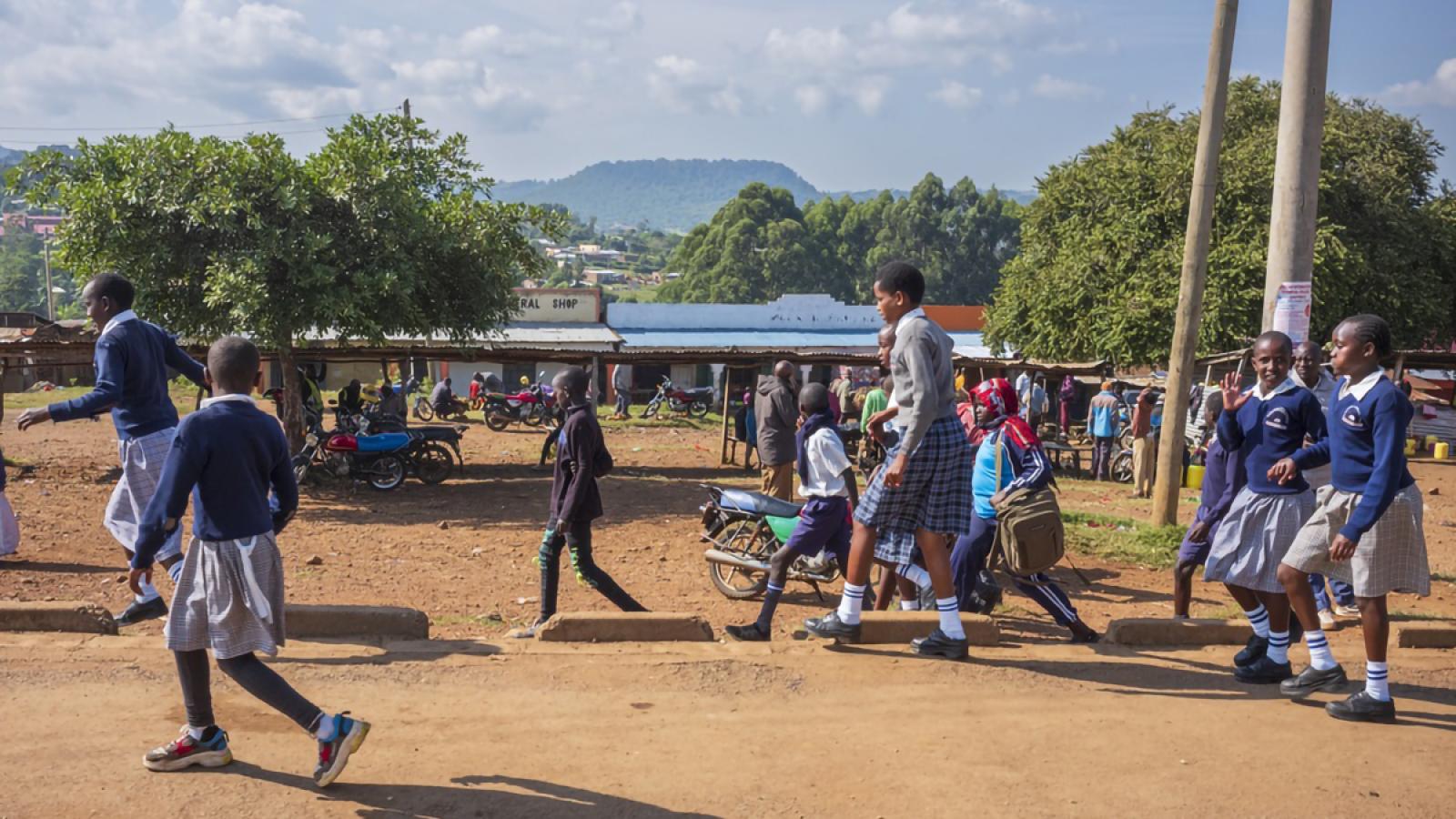
Twenty years ago, Development Economist and Nobel Laureate, Amartya Sen, remarked ‘Nothing really is as important in the world as getting children to school, especially female children’. Despite widespread consensus among development academics, INGOs and policymakers that female education is a critical pathway for development, we are not yet close to achieving gender parity across the world, but there are important signals of progress.
Our team at the Oxford Poverty and Human Development Initiative (OPHI) looked at data for children who are out of school in 108 countries in developing regions. We looked at whether they were also living in poor homes, or non-poor homes. The poverty measure we used was the global Multidimensional Poverty Index, which we co-publish with the United Nations Development Programme. The global MPI considers a person poor if they are deprived in at least a third of ten weighted indicators covering health, education and living standards. What we found shocked us. In developing regions, 82.1% of school-aged children who are both poor and out of school live in households where no woman, aged 18 or above, has completed at least six years of schooling (that’s 90.3 million children). This is compared with 62.4% who lack an equivalently educated man (68.6 million children), while 46.8% lack any adult with even one year of completed schooling.
We also looked at children under five, who are poor and also stunted or underweight, to see how many lacked an educated woman at home. We found that roughly two-thirds of poor children under five, regardless of nutritional status, live in households where no woman has completed six years of schooling, compared with about half who lack a man with an equivalent level of education. These disparities point to persistent educational disadvantages that may limit opportunities for women and girls across generations.
Before considering what it means to be a child in a household where no woman has completed primary education, let’s reflect on the experience of these women: mothers, grandmothers, aunties, older sisters. Without even six years of schooling, these women have been denied their basic right to education and potentially the opportunities that come with it, such as literacy, numeracy, intellectual freedom, the capacity to pursue fulfilling employment and perhaps the ability to exercise their voice in public and political life.
When we focus on what it means to be a child – whether a girl or a boy – growing up in a household where no woman has completed six years of schooling, the risks are clear. They may face greater health risks if caregivers have limited access to health-related information. And, whether they attend school or not, these children may receive less support for learning at home.
The completion of six years of schooling is a modest benchmark, but it represents the most common duration of primary education – which varies across countries – and it is the threshold used in the global MPI to measure deprivation in years of schooling. Six years of schooling in a poor-quality learning environment may not deliver adequate learning outcomes, but not accessing even that basic level of education is a profound injustice. These findings point to the need not only to strengthen efforts to ensure that all children finish secondary school, but also to invest in lifelong learning opportunities for adults – particularly women – who were left behind.
We trawled the data to see if and where other gender disparities exist. Our research found that while too many children of either sex are undernourished or out of school, the global patterns differ: more boys are undernourished than girls, while more girls are out of school than boys. But the picture is complicated. Gender disparities in school attendance vary considerably across countries. In 19 countries, representing 56% of all out-of-school children, girls face higher rates of school exclusion than boys. The largest gender gaps are found in Afghanistan, where the share of girls not attending school is 20 percentage points higher than the share of boys (67.1% compared with 47.1%), followed by Pakistan (30.2% and 22.3%), Central African Republic (29.3% and 21.5%), and Guinea (41.3% and 33.7%). Yet in 35 countries, accounting for 21.4% of all out-of-school children, boys are more likely than girls to be out of school. In 54 countries there is no significant gender disparity, but these countries are home to fewer than one in four school-aged children.
On a more positive note, change is already in progress. We identified 71 million ‘pioneer children’, children who are the only members of their household to have completed six years of schooling. Globally, 8.1% of girls are pioneer children compared to 7.7% of boys. This varies by region, but in no region is the difference between the share of girls and boys statistically significant.
Half of all pioneer children live in South Asia. In India, Bhutan and Bangladesh, the share of pioneer girls among girls aged 10–17 exceeds the share of pioneer boys among boys of the same age. In Bhutan, over one in five girls is a pioneer child. So, there is hope that the seeds of change are already being planted. But the message is clear: educational systems across the developing world need our continued focus and support to address gender disparity and promote equitable futures.
Sabina Alkire is Professor of Poverty and Human Development at the University of Oxford and the Director of the Oxford Poverty and Human Development Initiative.