Mahika Khosla, Shixin Zhao, and Moses Koo win 2026 MPhil prizes
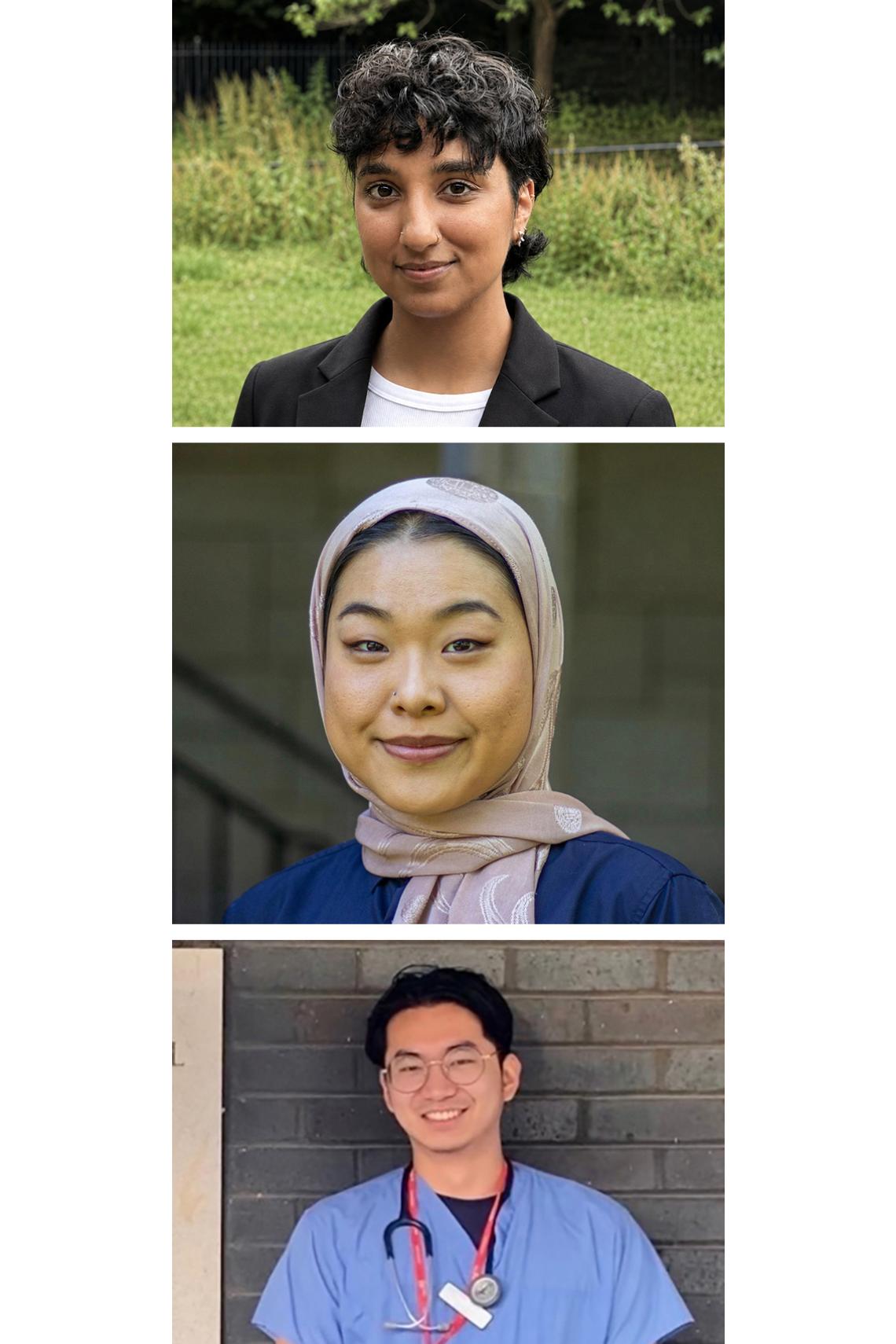
Congratulations to Mahika Khosla, Shixin Zhao, and Moses Koo who have won the 2026 prizes for their performance in the MPhil in Development Studies.
Mahika Khosla of St Antony’s College won the Eugene Havas Memorial Prize, the prize for the best overall performance.
Mahika’s thesis examined the politics of urban flooding in the southern Indian megacity Bengaluru’s informal settlements. Moving beyond dominant development narratives of “adaptation” and “resilience”, she explored how residents experience and navigate recurring flooding to foreground the everyday politics that emerge under conditions of environmental precarity. She developed a political ecology framework connecting urban land markets, logics of governance, and climate-oriented development agendas to elucidate how experiences of flooding for the urban poor are shaped by shifting dynamics with landlords, municipal agencies, and NGOs respectively. Ultimately, her thesis argued that flooding is a political outcome of uneven urbanisation that reflects and reconfigures longer-standing subaltern struggles over land, housing, ecology, and welfare in a world confronting intensifying climate injustice.
After graduation, Mahika will build on her MPhil research, developing it into a comparative, multi-city DPhil project at the Oxford Department of International Development. Through this work, she hopes to explore how different urban, land, and working class histories shape and constrain evolving forms of ecological politics in India.
Shixin Zhao of St Catherine’s College won the Papiya Ghosh Thesis Prize for the best overall thesis.
Shixin’s research examined how a diasporic mosque community in Barcelona sustains Islamic tradition across the ruptures of migration. Drawing on ethnographic fieldwork at Assafa Islamic Center – a ‘garage’ mosque in central Barcelona serving predominantly first-generation North African migrants – it adopted Hervieu-Léger’s framework of ‘religion as a chain of memory’ to ask how collective religious memory is evoked, managed, and transmitted in conditions of spatial constraint, cultural diversity, and legal-economic precarity. The thesis argued that the diasporic mosque functions as a mnemonic and generative site – not a passive custodian of the past, but an active producer of belonging.
Moses Koo of Wolfson College won the Examiners’ prize
His thesis examined how different individuals, communities, and organisational entities experienced and responded to the COVID-19 pandemic in South Africa, drawing from interviews with social activists, doctors, and community volunteers. In particular he examined the hospital-facing response centred around oxygen infrastructure, the community response through the Community Action Networks (CANs), and social movement building within the C19 People’s Coalition. He argued that the pandemic contained multiple crises which were biological, social, political, and infrastructural, which produced a variety of responses. Through examining these responses, he argued that the pandemic exposed deep structural weaknesses and inequalities, notably in healthcare, food security, and political mobilisation. Furthermore, while the pandemic itself was insufficient to confer deeper structural and political transformation, he argued it facilitated the construction of new infrastructures of solidarity and possibility for social transformation.
Moses is returning to work from August in the UK’s NHS, as a Clinical Teaching Fellow, where he will be helping Southend University Hospital’s medical education team teach medical students on placements from Queen Mary’s and Anglia Ruskin Universities, as well as working shifts in internal medicine to hone his skills in clinical medicine. His aspiration is to work in the field of Global Health one day as both a clinician and social scientist, and he is striving to cultivate a portfolio which balances these.