

Contemporary global drivers of land use changes in Africa
What is driving the sweeping transformation of land use across Africa – and how should we make sense of it? Here Phillan Zamchiya introduces the concept of globalised extractive territorialisation.
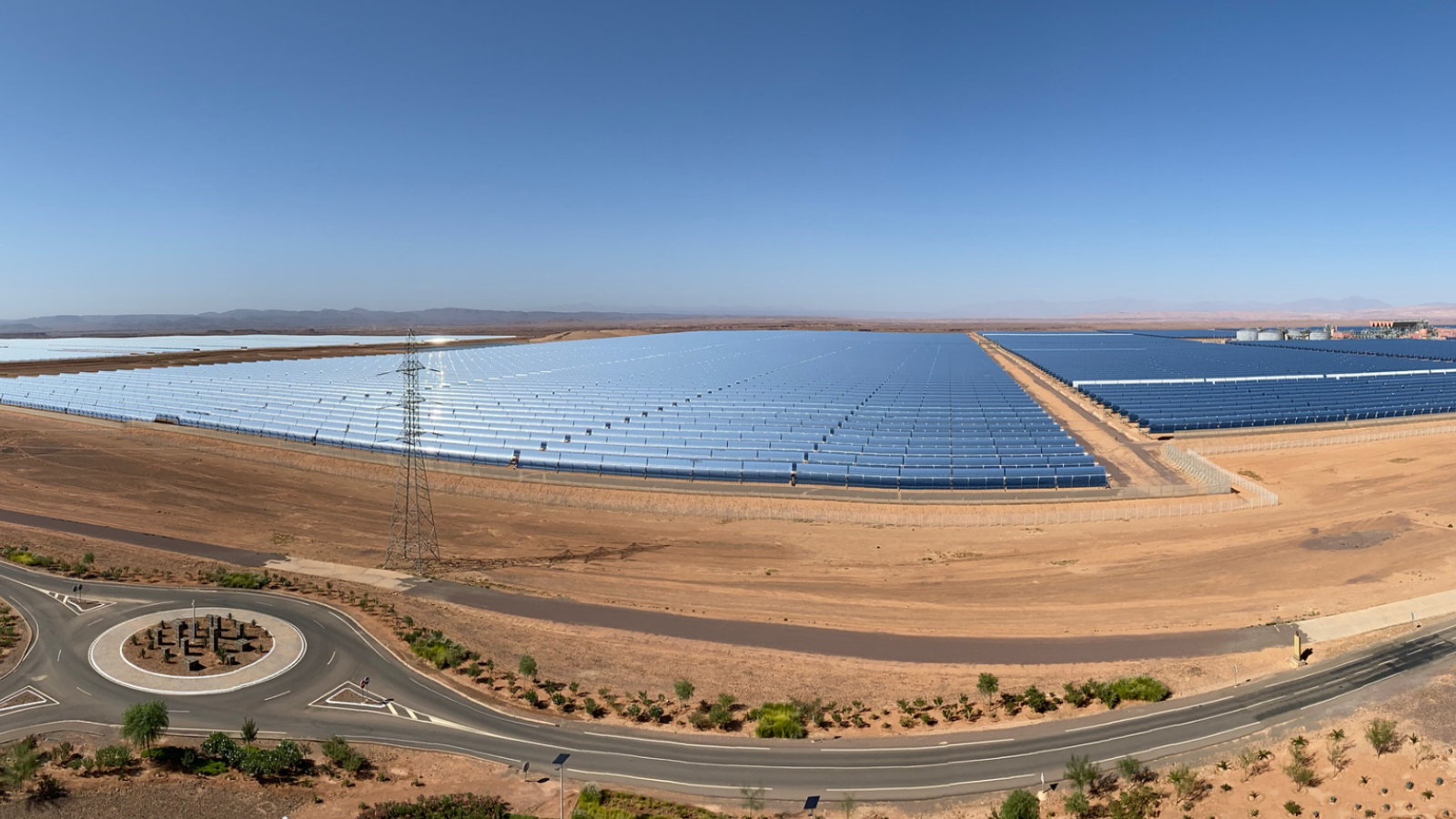
Noor 1 and 2, Ouarzazate Solar Power Complex, Morocco
Africa is undergoing one of the most rapid and consequential transformations of land use in the contemporary world. In this blog, I argue that these changes are best understood through what I term globalised extractive territorialisation, a concept introduced here to capture the systematic reorganisation of land beyond extraction alone.
Contemporary land use changes in Africa involve the systematic reorganisation of territory through offsets, concessions, and corridors, and large-scale infrastructure. These processes are globally organised and embedded in transnational markets, climate mitigation agendas, geopolitical competition, and development finance. They operate as a durable regime rather than episodic interventions, spanning agriculture, critical and rare-earth minerals, renewable energy, carbon markets, construction, demographic and urban expansion.
This regime is legitimised through persistent narratives that frame African land as empty, abundant, and underutilised, obscuring existing land uses and rendering current land users politically invisible. Institutions such as the African Development Bank (AfDB) continue to reproduce this frontier imaginary, shaping investment strategies and land governance across the continent.
Against this backdrop, I examine how this regime materialises through seven distinct but interconnected drivers of land-use change.
The most visible entry point of this regime is the global scramble for critical minerals.
Critical and rare-earth minerals are a central driver of land-use change in Africa under the global regime of extractive territorialisation.
Global decarbonisation, electrification, and digitalisation have sharply expanded demand for these minerals. Demand is projected to more than double by 2030 and quadruple by 2050, with annual revenues exceeding USD 400 billion.
Africa occupies a strategic position because it holds close to 30% of global critical mineral reserves. This includes 48% of cobalt, 40% of manganese, and 22% of graphite. The Democratic Republic of the Congo (DRC) supplies over 70% of global cobalt, while lithium extraction is rapidly expanding in Zimbabwe, Namibia, Mali, and Ghana.
China dominates mineral processing and DRC cobalt, while the United States and European Union mobilise finance and corridors to secure alternatives. Gulf states are entering the competition through large-scale copper and lithium investments.
These projects span vast territories, converting forest, cropland, and pasture at scale. Mining zones are tied into transport corridors, energy systems, and export routes, fixing territory into long-term extractive global supply chains.
The mineral frontier provides a template for how extractive territorialisation extends into other sectors under climate and development agendas.
Renewable energy marks the next iteration of this logic, reframing land from a site of extraction to one of climate-justified enclosure.
Its expansion is therefore not a neutral energy transition, but a reorganisation of land as a strategic asset serving external decarbonisation needs.
Solar and wind projects mobilise African land, sun, and labour, while ownership, finance, and control remain largely external. Across the continent, utility-scale solar capacity now exceeds 20 gigawatts and continues to expand through large-scale projects such as Kenya’s Lake Turkana Wind Power, which occupies roughly 40,000 acres of customary land and generates 310 megawatts, Egypt’s Benban Solar Park at around 1.65 gigawatts, and Morocco’s Noor Ouarzazate complex, exceeding 500 megawatts. Where customary land rights are weak or unrecognised, this expansion generates dispossession, social marginalisation, and environmental injustice, often without equivalent gains in local energy access or authority.
Renewable energy thus mirrors extractive industries by reorganising territory for external accumulation rather than local control.
Carbon markets intensify this logic, extending extractive territorialisation beyond energy production by reframing land as a carbon asset under climate mitigation agendas.
Territory is reorganised to serve external emissions reduction needs through large-scale sequestration, tree planting, and biodiversity offsets. These ‘green grabs’ now account for roughly 20% of global land acquisitions, with governments pledging close to one billion hectares worldwide for land-based carbon removal, a disproportionate share of which is located in Africa. Carbon is treated as a tradable unit, privileging measurable stocks over existing land uses, social relations, and customary claims.
This is institutionalised through initiatives such as the Africa Carbon Markets Initiative, which seeks to scale voluntary markets to 300 million credits annually by 2030 and 1.5 billion by 2050, with projected revenues exceeding USD 120 billion. Production is highly concentrated, with five countries accounting for roughly 65% of African issuances, led by Kenya, followed by Zimbabwe, the DRC, Ethiopia, and Uganda. REDD+ programmes in the Congo Basin exemplify this regime, with about 30–40 billion tonnes of carbon and home to roughly 75 million people.
Where renewable energy reorganises land for energy flows, carbon markets reorganise it for financialised climate offsets.
These sectoral pressures intersect with demographic change in ways that intensify land competition rather than explain it away.
Population growth is therefore a critical amplifier of extractive territorial pressures rather than constituting their root cause.
While global population growth is slowing, Africa’s demographic trajectory diverges sharply. The population is expected to reach 2.5 billion by 2050. More than half of global population growth will occur in Nigeria, the DRC, Ethiopia, Tanzania, and Angola.
In these contexts, demographic change heightens competition over already used landscapes. It intensifies subdivision, shortens fallow cycles, and accelerates conversion of forests, grasslands, wetlands, and marginal lands. This exposes the limits of demographic explanations detached from the global political economy, land governance, and prevailing territorial pressures.
Urbanisation is one of the primary spatial mechanisms through which these compounded pressures are territorialised.
It translates population growth and economic restructuring into large-scale conversion of farmland, wetlands, forests, and peri-urban commons. Africa remains less urbanised than other regions, with about 43% of its population living in cities, yet it is urbanising faster than anywhere else at roughly 3.5% per year. The urban population grew from under 30 million in 1950 to over 600 million by 2020 and is projected to approach one billion by 2050.
Since 1990, the number of cities has more than doubled. This pattern intensifies pressure on surrounding farmland and ecosystems. Metropolitan regions such as Lagos, Kinshasa, Cairo, Nairobi, and Johannesburg, Pretoria now host over ten million residents each.
Urbanisation translates demographic pressure into permanent land reallocation, reshaping land markets and accelerating peri-urban dispossession with lasting consequences for food systems and ecological sustainability.
Infrastructure and timber become the primary channels through which these urban pressures are territorialised, locking land into long-term material and extractive supply chains.
Global wood demand is projected to increase by 54% between 2010 and 2050, intensifying pressures on forested land and raising net atmospheric carbon.
China’s Belt and Road Initiative has been pivotal in scaling this process, with fifty-three African Union member states participating, USD 21.7 billion in construction contracts signed in 2023 alone, and Chinese firms accounting for around 31% of major construction projects across the continent.
Timber extraction is closely coupled to this infrastructure boom. While some timber feeds construction associated with infrastructure development in Africa, a substantial share is exported to China and other global markets, linking African forests to transnational construction supply chains. China absorbs more than three-quarters of Africa’s timber exports, importing 1.46 million cubic metres in the first half of 2024. Logging concessions are heavily concentrated in Central and Southern Africa, where forests are converted into extractive territories and rural livelihoods are undermined. Construction and timber thus function as a consolidated driver of land use change, mobilising African territory for global accumulation.
Agriculture is the sector in which these pressures converge most directly on everyday livelihoods.
Contemporary land use change reflects the growing corporatisation of crops within global and regional agri-food systems, rather than smallholder farming per se. Since the early 2000s, sub-Saharan Africa has recorded the world’s fastest rate of agricultural expansion, with nearly three-quarters driven by area expansion rather than yield intensification.
This expansion is shaped by export demand and state-backed visions of scale. Medium-scale farmers cultivating between 5 and 100 hectares now account for a substantial share of newly converted land, exceeding 50% in Ghana and around 40% in Zambia and Tanzania.
At the same time, policy imaginaries explicitly promote transformation on a bigger scale. The African Development Bank’s Feed Africa strategy commits more than USD 60 billion to large-scale agricultural corridors across forty countries, requiring an estimated 25.7 million hectares and affecting over 11 million smallholder farmers.
Small-scale farmers are not passive in this process. They respond rationally to insecure tenure, climate stress, declining soil fertility, limited non-farm employment, and rising food and cash needs by expanding cultivation where possible.
This convergence intensifies competition over land and marginalises agroecological alternatives. Agricultural land use change thus reflects a political economy that privileges commodification and territorial scale, anchoring extractive territorialisation in rural space not through subsistence failure, but through market-driven expansion.
These drivers together constitute a political–economic regime of land pressure in Africa, best understood as globalised extractive territorialisation.